Carta del editor asociado
Resumen
Mi interés en las acciones explosivas viene del atentado en el aparcamiento de la Terminal T4 de Barajas, que tuvo lugar el domingo 30 de diciembre de 2006, y que destruyó por casi por completo el módulo E del aparcamiento. El atentado causó dos muertos. Se estima que la carga explosiva estuvo entre 500 y 800 kg. Me tocó visitar el lugar dos veces ese día, debido a que FHECOR había desarrollado el proyecto de esta estructura. Cuando vi la destrucción causada, para la cual nadie me había preparado, sentí vértigo. Al día siguiente con más calma volví a visitar la obra ya más de cerca y pude observar varios tipos de rotura, nada usuales en las estructuras, inducidas por la inversión de la carga, en particular roturas limpias de la unión pilar forjado. Esta experiencia, de alguna forma traumática y transformadora, es la que ha llevado a que hoy pueda presentar esta revista monográfica de Hormigón y Acero dedicada a este tema.
El número abarca varios aspectos, desde temas teóricos a ensayos experimentales a experiencias prácticas.
En el aspecto teórico, Wilhelms et al. Introduce un concepto nuevo: el de los diagramas Energía-Potencia (E-P) como alternativa a los diagramas Presión-Impulso (P-I) tradicionales, que representan la combinación de estas magnitudes que puede resistir una estructura lo que permite, de golpe, verificar una estructura para distintos escenarios posibles, como el diagrama de interacción N-M. La ventaja fundamental del diagrama (E-P) es que estas magnitudes para un caso dado pueden determinarse directamente a partir de la distancia escalada y consideraciones geométricas, mientras que el diagrama (P-I) requiere un análisis dinámico.
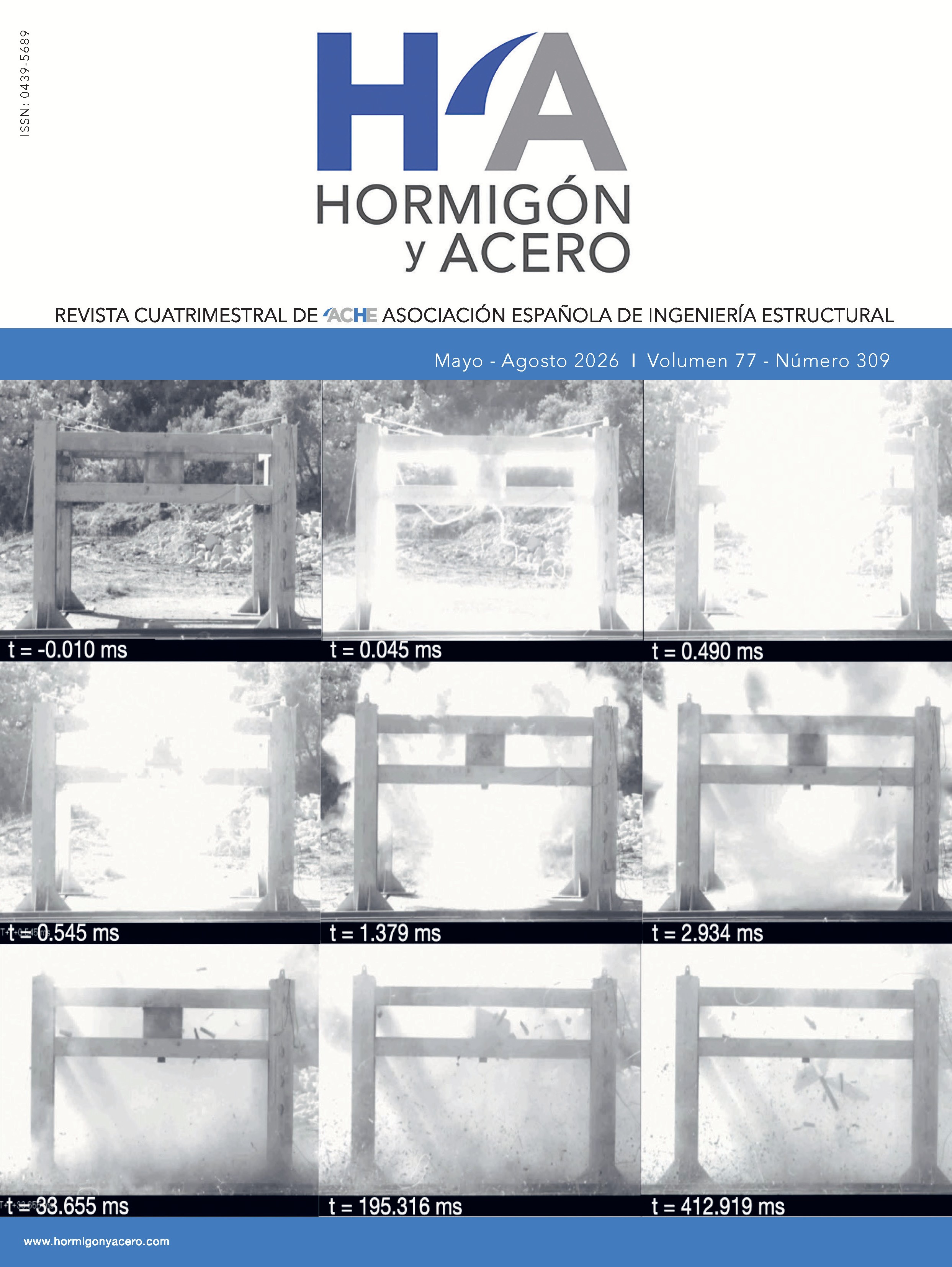
A este artículo le siguen cuatro artículos con una componente experimental. Chiquito et al. presentan un ensayo con explosivos sobre una estructura metálica sencilla que responde elásticamente, con el objetivo de medir a través de la respuesta, predecible, de la estructura el valor de la acción. Colombo et. al abordan el problema de la interacción explosión-fuego en túneles tomando como caso práctico los túneles sumergidos que se están considerando para cruzar los fiordos noruegos. Cendón et al. presentan una campaña experimental que consiste en cargas explosivas aplicadas sobre losas de hormigón autocompactante de alta resistencia reforzado con fibras metálicas. Para cerrar este bloque, Aminou et al. estudian la capacidad de absorción de energía de una espuma mineral frágil, utilizada como protección de una probeta metálica que representa una estructura.
Finalmente, hay dos artículos que abordan el tema desde el punto de vista práctico. Rodriguez el al. presentan su amplia experiencia profesional a través de casos prácticos de explosiones en cuyo análisis han participado a través de INTEMAC. Finalmente, Rodriguez describe la metodología seguida en la práctica para el análisis de situaciones accidentales en instalaciones industriales.
El conjunto representa una visión amplia de un problema que, desgraciadamente, cada vez resulta más importante por los desarrollos tecnológicos (drones, p.e.) y cuyo análisis los ingenieros estructurales deben incorporar a sus competencias.